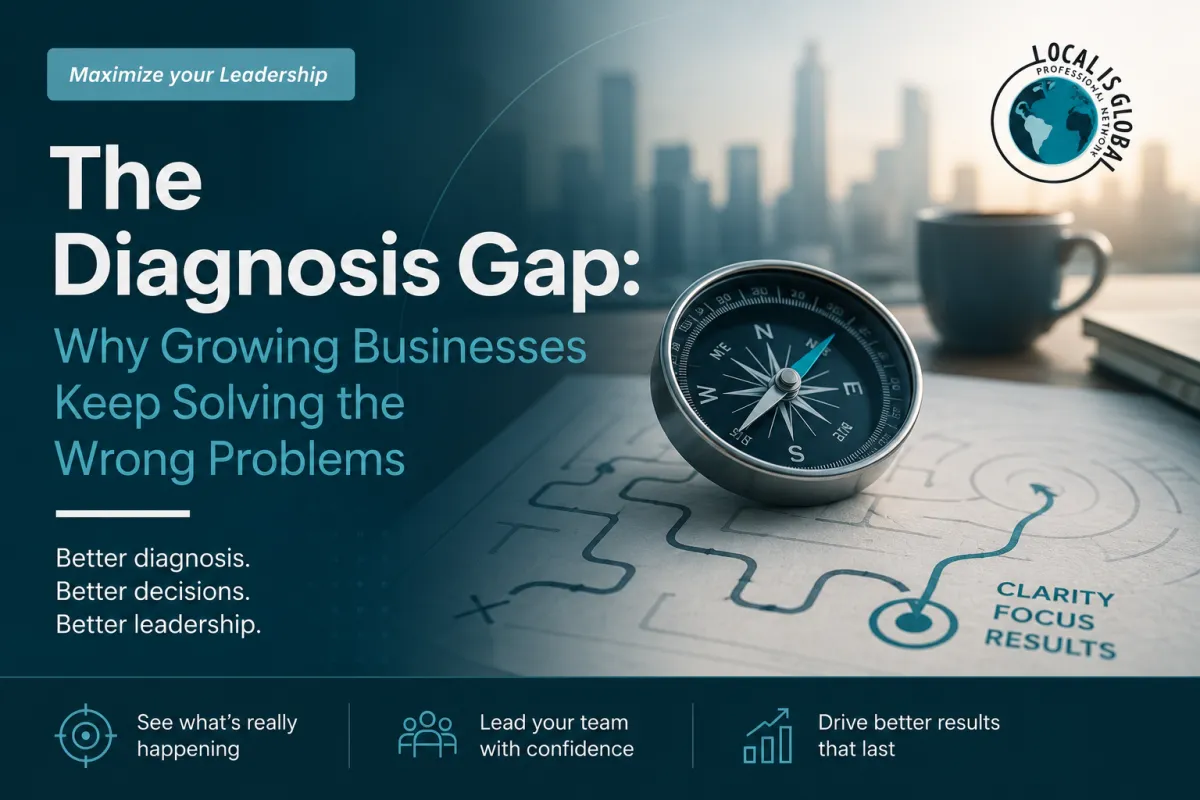
The Diagnosis Gap: Why Growing Businesses Keep Solving the Wrong Problems
The Diagnosis Gap – Part 1
You're Probably Solving the Wrong Problem: Why Leadership Conversations Fail Before They Even Begin
Walk into almost any leadership meeting and you'll hear familiar phrases:
"She isn't proactive enough."
"He lacks leadership skills."
"The team resists change."
"Communication is the problem."
These statements sound reasonable. They often become the foundation for performance reviews, training initiatives, coaching programs, and even organizational restructuring.
But there is one important question we rarely ask:
What evidence are these conclusions actually based on?
Too often, organizations make decisions about people using interpretations rather than observations.
We confuse personality with behavior.
We describe individuals instead of describing what they actually do.
And when that happens, improvement becomes difficult because people cannot change labels—but they can change behaviors.
The Cost of a Poor Diagnosis
In medicine, treating the wrong diagnosis can delay recovery.
Organizations are no different.
When the diagnosis is inaccurate, companies often invest significant time and resources in solutions that address symptoms rather than underlying causes.
Leadership programs are launched.
Communication workshops are organized.
New processes are introduced.
Yet months later, many of the same challenges remain.
Not because the solutions were necessarily wrong.
But because they were designed to solve the wrong problem.
Behavior Is Where Change Begins
At Local is Global, we've learned that meaningful organizational change begins long before any intervention.
It begins with understanding.
Before recommending training.
Before redesigning processes.
Before launching leadership initiatives.
We diagnose.
One of the most valuable shifts we've seen in organizations is moving conversations away from personality and toward observable behavior.
Behavior is visible.
Behavior can be discussed objectively.
Behavior can be measured in context.
Most importantly, behavior can be developed.
This creates a common language between leaders, managers and teams—one based on evidence rather than assumptions.
When conversations become more objective, feedback becomes more useful.
Trust increases.
Resistance decreases.
And leaders are finally able to focus on what truly influences performance.
Better Questions Lead to Better Decisions
Organizations don't improve simply because they collect more information.
They improve because they learn to ask better questions.
Before investing in another leadership program, another workshop, or another organizational initiative, it may be worth asking:
Have we truly identified the behaviors that are limiting our strategy—or are we reacting to assumptions?
Because sustainable change rarely begins with a solution.
It begins with an accurate diagnosis.
The Diagnosis Gap is a series of reflections on why organizations often struggle—not because they lack talent or strategy, but because they haven't fully understood the challenges they are trying to solve.
Dr. Laura Alcaide Zugaza
CEO Local is Global
www.localisglobal.net
